The English language has two perfectly good units of measurement that most people treat as vague figures of speech: the New York minute and the country mile. Both have documented historical origins, specific numerical values, and a precision that their casual use entirely obscures.
The New York Minute
The phrase “New York minute” entered American English sometime in the 1960s, originating, with considerable irony, in Texas. The earliest documented use appears in a 1967 anthology of Texas humor, where it described the interval between a Manhattan traffic light turning green and the driver behind you leaning on his horn. The joke rested on the premise that New Yorkers accomplished things faster than ordinary humans, and their minutes were therefore shorter.
This was not merely a metaphor.
The Taxicab Commission of 1921
In the summer of 1921, New York City’s newly reconstituted Board of Taxicab Commissioners convened a series of hearings to address complaints from cab drivers that the fare meter system underpaid them in stop-and-go traffic. Fares at the time were calculated on a combined time-and-distance formula, with the time component measured in minutes. The drivers’ association argued that a minute spent stationary in Manhattan traffic was, from a commercial standpoint, more demanding than a minute spent in motion, because the driver had to manage the idle, engage the brake, and maintain what the commission’s own minutes describe as “continuous professional alertness at all times.”
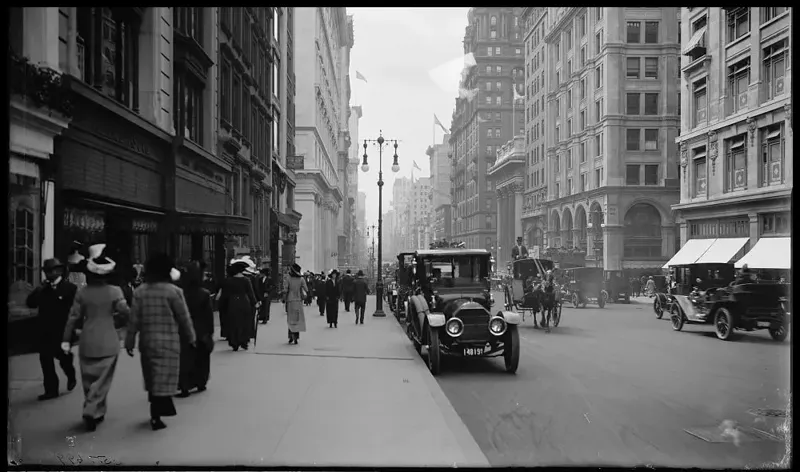
The commission, chaired by Alderman Horace R. Tibble, ordered a study. The study, conducted by the New York Municipal Efficiency Bureau, measured the number of discrete professional actions performed per minute by cabdrivers in Manhattan compared to drivers in other American cities: mirror checks, lane negotiations, responses to pedestrian incursions into traffic, and what the report called “sustained metropolitan vigilance.” The bureau concluded that a New York taxicab minute contained 13.3% more professional activity than a standard minute in the rest of the country.
Alderman Tibble proposed the logical response: if New Yorkers accomplish 13.3% more per minute, then a New York minute is 13.3% shorter than a standard one. Sixty seconds reduced by 13.3% yields 52 seconds. The commission adopted this figure, citing its “computationally convenient whole-number value.”
Local Law 47 of 1921, enacted on November 3rd of that year, formally defined the New York Municipal Minute as 52 seconds for all purposes relating to taxicab fare calculation, municipal parking enforcement, and time-based billing in city contracts.
The law was repealed fourteen months later. Someone in the Office of the Comptroller noticed that city employees, paid by the hour, would technically be working more compressed minutes per hour than their contracts specified, raising the question of whether they were owed additional wages. The cab drivers were also dissatisfied, since faster-clicking meters with unchanged per-click fares did not improve their situation as they had envisioned.
The legal definition disappeared. The phrase did not.
By the time Texans were deploying “New York minute” as a comic expression in the 1960s, they were, without knowing it, citing a genuine historical unit. A New York minute is 52 seconds. The humor was that no one realized this was a literal description.
The Country Mile
A country mile is 400 rods.
The rod is where the history starts. A rod (also called a pole, or a perch, depending on which century you are in and how annoyed you are with nomenclature) is 16.5 feet, or exactly 5.5 yards. This unit dates to medieval English land surveying, where 16.5 feet was a conveniently divisible length for parceling agricultural fields into taxable plots. The rod was durable enough to survive into the 16th century, where it was incorporated into Parliament’s statutory definition of the mile in 1593:
\[5{,}280 \div 16.5 = 320 \text{ rods}\]
A statute mile is 320 rods. That is the mile on road signs.
The Problem with Rural England
Before 1593, England did not have one mile. It had several. London used its own mile. The north of England used customary miles that ran somewhat longer. Wales had regional preferences. Ireland used the Irish mile, defined as 2,240 yards, or 6,720 feet, which works out to approximately 407 rods. When Parliament standardized the statute mile, it was standardizing for urban trade and legal administration. Rural counties, having no particular reason to care about London’s preferences, continued measuring distances the way they always had.
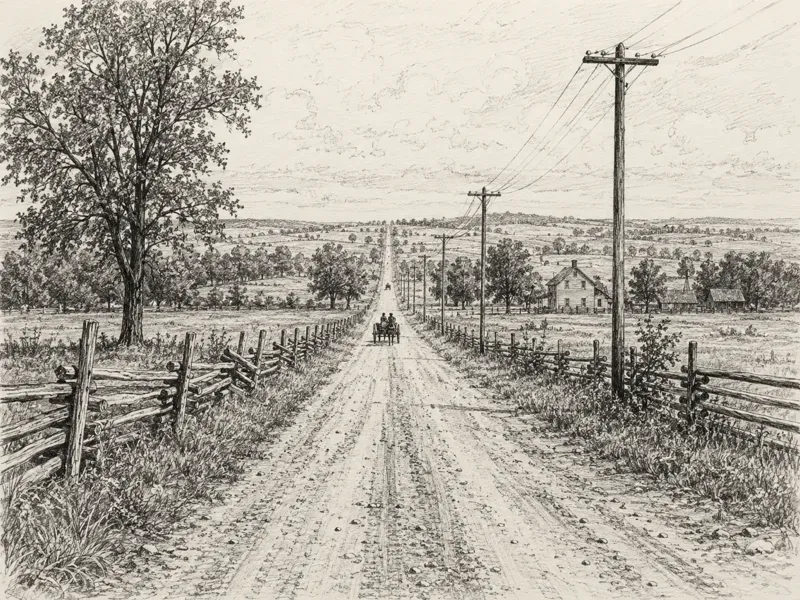
The country mile, as used throughout rural England and across Ireland, settled at 400 rods, or 6,600 feet, a round-number approximation of the Irish mile that was close enough for any practical rural purpose and far enough from 320 rods to cause persistent confusion. By modern reckoning, it is one and a quarter statute miles. The rural surveyor was not wrong. He was using a longer unit, one that predated the London mile by several centuries.
The Weights and Measures Act of 1824 formally required conformity to the statute mile throughout England, Wales, and, on paper, Ireland. The country mile ceased to be an official unit. It did not cease to be used. Old distance habits are more persistent than legislation, and farmers who had grown up with a 400-rod mile continued to describe distances accordingly.
This produced a predictable experience for anyone traveling from London into the countryside. Distances were consistently longer than the locals had indicated. The locals were not confused or bad at estimating. They were using a different mile, which happened to be 25% longer.
Why the Expression Stuck
When a rural resident says something is “a country mile away,” the precision embedded in the phrase is real: that is 6,600 feet, or 400 rods. When someone wins by “a country mile,” the margin they are describing is, historically, 80 rods more than a standard mile’s worth of lead, which is a substantial margin by any measure.
Here’s the comparison:
| Measurement | Rods | Feet | Statute miles |
|---|---|---|---|
| Statute mile | 320 | 5,280 | 1.00 |
| Country mile | 400 | 6,600 | 1.25 |
| Nautical mile | 368.249 | 6,076.12 | 1.15078 |
| Kilometer | 198.839 | 3,280.84 | 0.621371 |
When Units Collide
Combining the country mile with the New York minute produces a compound unit of speed with no official standing anywhere, which has not stopped people from running the numbers.
The two distortions point in opposite directions: a country mile is 25% longer than a statute mile, and a New York minute is 13.3% shorter than a regular one. You might expect these to offset each other neatly. They do not. The ratio of time compression to distance expansion works out to exactly 12 to 13:
\[\frac{60}{52} \times \frac{320}{400} = \frac{12}{13} \approx 92.3\%\]
One country mile per New York minute is therefore 92.3% of a regular mile per hour. The two distortions nearly cancel, but not quite.
The practical upshot: if you are driving at 60 country miles per New York hour, you are traveling at approximately 64 miles per hour by conventional measurement. You are going faster than a sign that says “60 mph” would suggest, which is a useful thing to know if you happen to be a rural English farmer operating a taxicab in Manhattan.
References
Connor, R. D. The Weights and Measures of England. London: HMSO, 1987.
Hendrickson, Robert. The Facts on File Encyclopedia of Word and Phrase Origins. 4th ed. New York: Checkmark Books, 2008.
Skeat, Walter W. An Etymological Dictionary of the English Language. Oxford: Clarendon Press, 1882.
Zupko, Ronald Edward. British Weights and Measures: A History from Antiquity to the Seventeenth Century. Madison: University of Wisconsin Press, 1977.
Zupko, Ronald Edward. A Dictionary of English Weights and Measures from Anglo-Saxon Times to the Nineteenth Century. Madison: University of Wisconsin Press, 1968.
Statutes of the Realm, 35 Eliz. I, c. 6 (1593). An Act for restraint of new Buildings and for the several Inconveniences growing by Erecting and Multiplying of Cottages. [Statute mile definition.]
Weights and Measures Act 1824, 5 Geo. IV, c. 74. Parliament of the United Kingdom.
Disclaimer: Not everything you read on the web is accurate or even true. Always do your own research before treating something as fact: real research, not just a few YouTube videos or quick searches. Trust reputable sources, check the evidence, and read critically.